The era of obvious, poorly translated crypto scams is officially dead. As we navigate the complex financial waters of 2026, the blockchain ecosystem has undeniably matured. Institutional capital now flows freely through spot ETFs. Decentralized finance protocols seamlessly handle billions in daily volume. Furthermore, modern Web3 infrastructure is practically invisible to the average end user.
However, this incredible, seamless integration comes with a devastating dark side. The landscape of fraud in 2026 is absolutely ruthless. It is automated, highly personalized, ruthlessly efficient.
Threat actors have completely abandoned crude phishing emails. Instead, they favor hyper-sophisticated, AI-driven social engineering tactics and deeply embedded smart contract exploits. Today’s malicious actors aggressively leverage localized Large Language Models (LLMs). They use these AI tools to scrape a victim’s entire on-chain history and social media footprint. This allows them to craft personalized attack vectors capable of bypassing even the most paranoid user’s defenses.
This rapid, terrifying evolution of the cryptocurrency scam has forced users, developers, and global law enforcement into a perpetual, exhausting arms race. But there is hope. A transparent ledger means the money always leaves a digital trail. Experts are currently developing unprecedented methods to track, freeze, and successfully recover stolen assets.
The 2026 Paradigm Shift in Blockchain Fraud
To understand exactly how to recover stolen digital assets, you must first comprehend how they are actually stolen. The primary attack vectors of 2026 look fundamentally different from those utilized during previous bull markets.
Old security measures simply do not work anymore. Standard hardware wallets and basic seed phrase protection are no longer sufficient to guarantee your safety against advanced persistent threats (APTs). Hackers no longer care about stealing your seed phrase. Today, they want your digital signature.
Signatures Over Seed Phrases
With the widespread, global adoption of Account Abstraction (ERC-4337), standard crypto wallets have evolved into highly programmable smart contracts. This technological leap allows for massive user experience improvements. We now enjoy features like social recovery and seamless gasless transactions.
However, this innovation also introduces incredibly complex attack surfaces. Scammers now routinely deploy malicious decentralized applications (dApps). These fake apps trick users into blindly signing complex, obfuscated parameters. You might think you are simply claiming a routine token airdrop or signing a standard governance vote. In reality, you are authorizing a devastating multi-call transaction. In a single block, this malicious code systematically drains your liquidity pool positions, un-stakes your validator nodes, and transfers your stablecoins straight to a fresh burner address.
Artificial intelligence has drastically lowered the barrier to entry for orchestrating these highly convincing operations. Generative AI models can perfectly clone the voice and visual likeness of prominent Web3 founders. Consequently, scammers run automated, real-time video feeds on major platforms like X and YouTube. They broadcast “live” AMAs (Ask Me Anything) where deepfaked industry leaders announce emergency token migrations or exclusive staking pools. To the untrained eye, these broadcasts are utterly indistinguishable from reality. Victims connect their wallets to the provided malicious links, sign the contract, and instantly lose everything.
What Are Some Crypto Scams? Dissecting the Threats
When rigorously analyzing the biggest crypto scams of the past decade, a very clear pattern emerges. Fraudsters consistently prey on a sense of urgency, technical opacity, and the intense fear of missing out (FOMO). But today, these mechanics have scaled into massive, industrial operations. Let’s dissect the specific architectures of the threats currently dominating the market.
Synthetic Voice and Deepfake Extortion
Perhaps the most chilling advancement in modern social engineering is the synthetic kidnapping and deepfake extortion racket. Fraudsters meticulously identify high-net-worth individuals. They specifically target developers or early token adopters whose vast wealth is easily verifiable on-chain.
Attackers gather fragmented audio from public podcasts, Twitter Spaces, or recorded interviews. Next, they train elite voice synthesis engines to mimic the target perfectly. They then initiate highly distressed phone calls to the victim’s family members, colleagues, or protocol co-founders. The AI voice claims a compromised wallet emergency or imminent physical danger, aggressively demanding immediate stablecoin transfers to a specified address. Because the synthetic voice carries the exact cadence, tone, and emotional inflection of the trusted individual, the success rate of these attacks is terrifyingly high. This is no longer just a digital exploit; it is pure psychological warfare.
Zero-Knowledge Rollup Sequencer Spoofing
As Ethereum and other Layer-1 networks offloaded their heavy transaction execution to Layer-2 and Layer-3 networks using Zero-Knowledge (ZK) proofs, scammers immediately found new hunting grounds. While ZK cryptography itself remains mathematically secure, the centralized components of these specific networks have become prime targets. Specifically, attackers target the sequencers that order transactions before batching them to the mainnet.
Sophisticated criminal syndicates deploy shadow interfaces. They actively route a user’s transaction through a malicious sequencer. The user interface displays a completely normal transaction status. Meanwhile, the sequencer intentionally delays the proof generation. It then injects a malicious transaction just ahead of the victim’s order. This is a highly advanced form of Maximum Extractable Value, or MEV, manipulation. The victim’s slippage tolerance is ruthlessly exploited to the maximum. Their funds are drained in what appears to be a totally routine decentralized exchange (DEX) swap. The inherent complexity of Layer-2 bridging makes tracking these stolen funds significantly harder for the average retail user.
Address Poisoning and UI Spoofing
Despite heavily increased community awareness, address poisoning remains a wildly successful attack vector. This is largely due to the sheer volume of transactions that active traders execute daily.
Scammers constantly monitor the blockchain mempool for high-value transfers. When a victim sends funds to a legitimate address, the attacker springs into action. They instantly generate a vanity address featuring the exact same first four and last four alphanumeric characters as the real address. They immediately send a micro-transaction (often zero-value) from this fake address directly to the victim.
The trap is now set. The fake, poisoned address sits quietly in the victim’s recent transaction history. The next time the victim needs to send funds to their trusted counterparty, human nature takes over. They instinctively copy the most recent address from their wallet interface to save time. They unknowingly paste the poisoned address, confirm the transaction, and send their precious assets directly to the hacker. In 2026, automation allows attackers to poison millions of addresses per minute, transforming this exploit into a highly lucrative numbers game.
How to Tell a Crypto Scammer? (And Knowing If You’re Chatting With One)
Identifying a modern threat requires extreme vigilance. How do I know if I am chatting with a scammer? First, you must recognize that scammers operate by creating panic. Fraudsters prey heavily on manufactured urgency. If an “account manager” or a supposed “protocol founder” is rushing you to move funds, you are likely talking to an attacker.
Furthermore, visual verification is no longer foolproof. Scammers run automated, real-time video feeds showing “live” AMAs with deepfaked industry leaders. These broadcasts announce fake emergency token migrations and are indistinguishable from reality. If you receive an unsolicited link to a “live rescue portal” or an “exclusive staking pool” via Discord or X, treat it as hostile. Authentic developers will never force you to sign obfuscated parameters to “save” your liquidity pool positions. If the situation feels desperate or too good to be true, disconnect your wallet immediately. If you need a trusted resource to verify if an address or protocol is flagged, communities dedicated to exposing these threats, like Bitcoin Scam Watch, are essential for checking the legitimacy of the platforms you interact with.
Tracing the Untraceable: Inside Blockchain Forensics
A common, dangerous misconception is that cryptocurrency transactions are entirely anonymous and completely irreversible. While it is true that transactions cannot be reversed on the base protocol level, total anonymity is a myth. Blockchains are pseudonymous.
Every single transfer, every token swap, and every smart contract interaction is permanently etched into a public, globally distributed ledger. Dedicated resources tracking a cryptocurrency scam offer crucial, step-by-step guidance on how this radical transparency is effectively weaponized against the criminals.
Elite on-chain forensic firms currently work alongside governmental cybercrime divisions. They utilize highly advanced data clustering algorithms to track stolen capital. When a massive hack occurs, the stolen assets rarely sit still for long. The hacker must frantically launder the funds to eventually off-ramp them into usable fiat currency. This complex process usually involves “chain-hopping” (bridging assets across multiple distinct blockchains like Ethereum, Solana, and Monero) and aggressively utilizing decentralized mixers.
Investigators combat this sophisticated laundering with probabilistic heuristics. They don’t just look at where the money goes; they deeply analyze the surrounding metadata. They meticulously analyze transaction timing, gas fee spending patterns, wallet interaction webs, and critical IP address leaks from centralized RPC nodes. For example, if a hacker bridges 500 ETH to an obscure Layer-2 network, and exactly 12 seconds later, a seemingly unconnected wallet on that same Layer-2 deposits exactly 499.8 ETH into an offshore centralized exchange, the algorithm instantly flags the correlation.
Furthermore, modern forensic tools now map “dust” transactions. Hackers frequently leave tiny, forgotten fractions of tokens in intermediary wallets. Investigators track these minute micro-balances, eventually linking seemingly isolated wallets directly to a single master entity. Once a definitive cluster is identified, the net tightly closes. The very moment any fraction of those laundered funds touches a centralized entity bound by KYC (Know Your Customer) regulations, the investigators strike.
Crypto Scams How to Get Money Back: The 4-Phase Recovery Blueprint
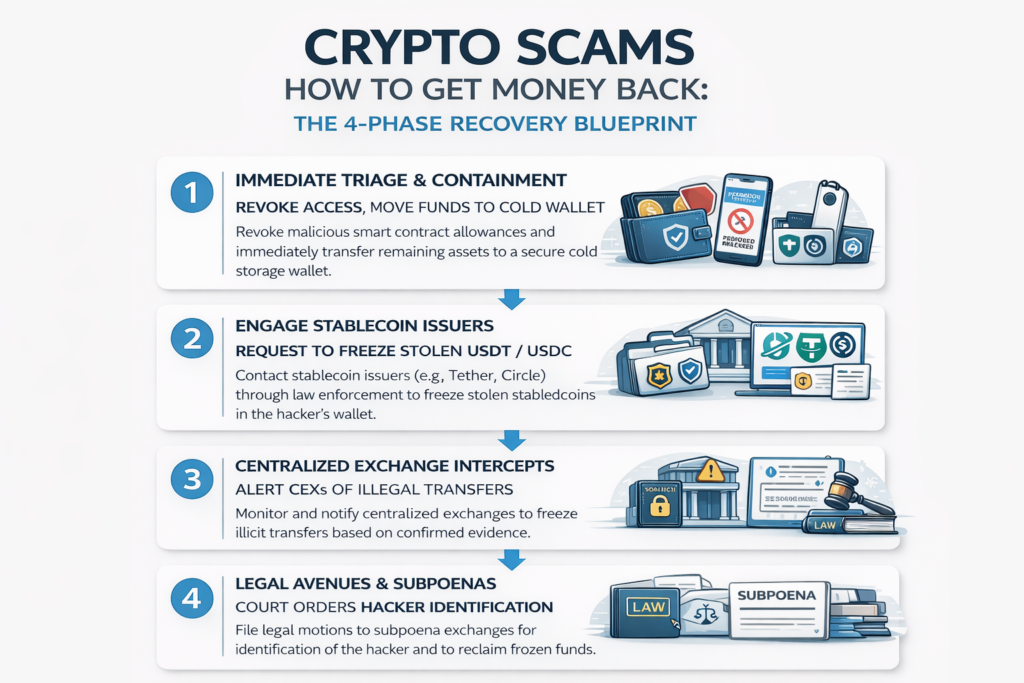
When millions vanish in a single malicious transaction, the immediate reaction is total despair. The immutable nature of blockchain technology feels like a heavy curse when your wallet is drained. The panic that sets in is paralyzing.
However, time is the absolute most critical factor. The faster a victim acts, the higher the probability of successfully intercepting the funds before they hit a decentralized mixer or a non-compliant offshore exchange. Here is the exact, expert-backed blueprint used to recover stolen digital assets in 2026.
Phase 1: Immediate Triage and Containment
The absolute moment an unauthorized transaction is detected, the victim must fiercely revoke all smart contract allowances. Tools like Revoke.cash, or your native wallet security features, must be deployed to sever the connection between the compromised wallet and any lingering malicious dApps. Sending your remaining safe funds directly to a fresh, highly secure cold wallet is paramount.
Simultaneously, victims must track the immediate destination of the stolen funds utilizing block explorers. Scammers frequently park stolen funds in intermediary addresses for a few tense hours before beginning the complex laundering process. Capitalizing on this brief window is crucial.
Phase 2: Engaging Stablecoin Issuers for Asset Freezing
If the stolen digital assets include centralized stablecoins like USDT (Tether) or USDC (Circle), your recovery prospects actually increase dramatically. Unlike decentralized assets like pure Bitcoin or Ethereum, centralized stablecoin issuers strictly retain administrative control over their underlying smart contracts. They possess the sheer power to blacklist specific addresses, effectively freezing the funds dead in the hacker’s wallet.
However, Tether and Circle absolutely do not freeze funds based on an angry tweet or a simple customer service ticket. They require robust, formal requests directly from law enforcement agencies or highly reputable blockchain forensic firms. Victims must immediately file comprehensive reports with their local cybercrime authorities. This means contacting the FBI’s IC3 in the United States, or the equivalent branches under Europol. You must provide the exact transaction hashes, the hacker’s identified address, and an immutable, factual narrative of the theft.
Phase 3: Centralized Exchange (CEX) Intercepts
Hackers eventually desperately need liquidity. They need to turn that stolen crypto into usable fiat currency to actually profit. To accomplish this, they almost always interact with a centralized exchange at the very end of their laundering cycle.
Elite on-chain investigators utilize their proprietary software to aggressively monitor the hacker’s known addresses 24/7. They set up automated, real-time alerts for the exact moment the funds hit a deposit address associated with major platforms like Binance, Kraken, Coinbase, or even lower-tier offshore exchanges.
When an alert officially triggers, forensic firms immediately contact the target exchange’s compliance and security teams. Most reputable exchanges currently operate under very strict anti-money laundering (AML) frameworks. Upon receiving credible, verified evidence of stolen funds entering their platform, they will forcefully freeze the user’s account pending a formal law enforcement subpoena. This is exactly where cross-border cooperation shines. Exchanges securely hold the funds in escrow while the victim’s dedicated legal team secures a judge’s court order compelling the exchange to return the assets.
Phase 4: Legal Avenues and the “John Doe” Subpoena
Navigating the legal system within the Web3 sector requires highly specialized attorneys. When stolen funds are successfully frozen on a centralized exchange, the victim must rapidly initiate a civil lawsuit.
Because the true identity of the hacker is usually entirely unknown at this stage, lawyers file what is legally known as a “John Doe” lawsuit directly against the anonymous owner of the wallet address. This specific legal maneuver allows the presiding court to issue powerful subpoenas directly to the centralized exchange. The subpoena legally forces the exchange to hand over the KYC data deeply associated with the account where the stolen funds were deposited.
Suddenly, the shadowy, anonymous hacker has a real name, a physical address, a government ID, and a traceable bank account history. From here, asset recovery beautifully transitions from a complex blockchain problem to a traditional legal asset seizure. Lawyers then utilize standard garnishments and aggressive asset forfeiture protocols. Resources and guidance available at hubs like Bitcoin Scam Watch can prove invaluable for victims trying to understand these complex legal recovery frameworks.
Proactive Defense Mechanisms: Hardening Your Web3 Posture
Recovery is technically possible, but it is incredibly expensive, deeply stressful, and sadly never guaranteed. The ultimate, absolute strategy against an emerging cryptocurrency scam requires adopting a truly institutional-grade security posture. Retail investors must learn to operate with the exact same paranoia and robust infrastructure as billion-dollar hedge funds.
Hardware Enclaves and Biometric Signatures
The standard, old-school USB hardware wallet is rapidly evolving. In 2026, premium cold storage solutions effectively utilize isolated hardware enclaves securely housed within mobile devices. They require multi-factor biometric authentication—such as retina scans or advanced facial topography—to legally sign any transactions. This powerful tech ensures that even if a physical device is stolen, or a computer is compromised via malware, the transaction simply cannot be broadcast to the network without the physical, verified presence of the true owner.
Multi-Party Computation (MPC) Wallets
Basic seed phrases are massive single points of failure. If you lose those 24 words, you lose the money forever. If someone finds those 24 words, you lose the money instantly.
The industry is rapidly and thankfully shifting toward Multi-Party Computation (MPC). In a modern MPC setup, the private key is physically never generated in its entirety. Instead, complex cryptographic “shards” are widely distributed across multiple devices (e.g., your smartphone, a secure cloud server, and a dedicated hardware device). To execute a transaction, a specific threshold of these devices must securely collaborate to sign the data without ever reassembling the full key. If a hacker heavily compromises your laptop, they only get a completely useless shard. This technology drastically reduces the overall success rate of phishing and advanced malware attacks.
Transaction Simulation Extensions
Blind signing is undeniably the root cause of most modern smart contract exploits. Users blindly hit “Approve” without actually knowing what the underlying contract will do to their wallet. Modern security absolutely requires mandatory transaction simulation.
Advanced browser extensions and modern wallet native features now intercept the transaction just before it is finally signed. They run the code through a localized, strictly sandboxed virtual machine. The simulator cleverly translates the complex hexadecimal data into plain, understandable English. It clearly displays critical warnings like: “Warning: If you sign this transaction, 50,000 USDC will leave your wallet, and you will receive a worthless NFT in return.”. These deterministic simulations act as the final, absolute critical firewall against malicious dApps and cleverly hidden drainer scripts.
The Regulatory Reckoning: Global Enforcement in 2026
The wild west days of cryptocurrency are definitively ending. The strict implementation of frameworks like the Markets in Crypto-Assets (MiCA) regulation in the European Union, alongside aggressive enforcement actions by the SEC and CFTC in the United States, has forced the industry to mature rapidly. Governments are no longer viewing blockchain tech as a niche hobby. They now actively treat it as critical global financial infrastructure.
Global, multi-national task forces are currently sharing real-time threat intelligence. Interpol’s highly dedicated digital assets division now coordinates seamlessly with national agencies. They execute massive, synchronized raids on physical scam call centers operating in Southeast Asia and Eastern Europe. These specific syndicates, which run the industrial-scale deepfake and advanced phishing operations, are currently being systematically dismantled.
Furthermore, the core legal liability is noticeably shifting. Decentralized autonomous organizations (DAOs) and independent protocol developers are facing intensely increased pressure to build robust consumer protections directly into their core codebases. Lifesaving features like time-locked transactions, social recovery modules, and automated threat detection are rapidly becoming mandatory industry standards rather than optional, nice-to-have add-ons.
As the ecosystem continuously pushes forward, the ultimate responsibility firmly rests on a tight combination of robust technological infrastructure, aggressive legal frameworks, and hyper-vigilant users. The biggest crypto scams will undeniably continue to evolve, aggressively leveraging artificial intelligence and even quantum-resistant cryptography. But the powerful tools to fight back, to successfully track the untraceable, and to legally reclaim what was stolen have truly never been stronger. Survival in the modern Web3 landscape simply demands nothing less than absolute, paranoid mastery of your digital sovereignty.
Stay vigilant, stay informed, and always verify your steps with trusted watchdogs like Bitcoin Scam Watch before signing your digital life away.
Report A Scam

Recent Posts
-
 New Cryptocurrency Scam Platforms in 2026 Explained By Bitcoin scam watch
 -
 Rising Crypto Scams in 2026 – Experts Reveal Recovery Options
 -
 AI Trading Scams Surge in 2026 – Experts Warn Investors About Fake Crypto Platforms
 -
Securing Your Digital Wealth: A Comprehensive Guide To Recovering Lost Cryptocurrency
-
Bitcoin Scam Watch Launches Premier Crypto Recovery Service for Lost Assets