The intersection of decentralized finance and traditional foreign exchange has birthed a terrifying new breed of financial predators. If you think you are safe because you know how to spot a boiler room cold-caller from the 1990s, you are sorely mistaken. Today’s malicious actors operate with absolute institutional precision.
They seamlessly deploy artificial intelligence, spoofed liquidity pools, and psychological warfare to siphon retail capital at terrifying speeds. The sheer velocity of money moving across global markets leaves uneducated traders entirely exposed to the modern forex scam.
Retail trading is inherently a high-friction environment. When you add unregulated offshore entities and sophisticated social engineering into the mix, you have a perfect recipe for total financial ruin. Criminal syndicates are no longer just cold-calling victims; they are building incredibly complex, synthetic trading ecosystems. These traps look, feel, and operate exactly like tier-one brokerages. You check your terminal, and the spreads look incredibly tight. The order execution seems absolutely flawless. You watch your balance go up.
But the brutal truth? The money was gone the exact moment it left your wallet. This month has seen a massive, coordinated spike in attacks targeting retail FX and crypto traders. This briefing deconstructs the exact methodologies syndicates are using, how their infrastructure functions, and the harsh realities of asset retrieval.
The Anatomy of a Modern Synthetic Brokerage
The traditional forex scam used to rely on aggressive brokers pushing clients to take massive, highly leveraged positions against the broader market. The broker would take the other side of the trade—known as the B-Book—and simply wait for the client to inevitably blow their account.
That was the old game. The modern game is entirely synthetic.
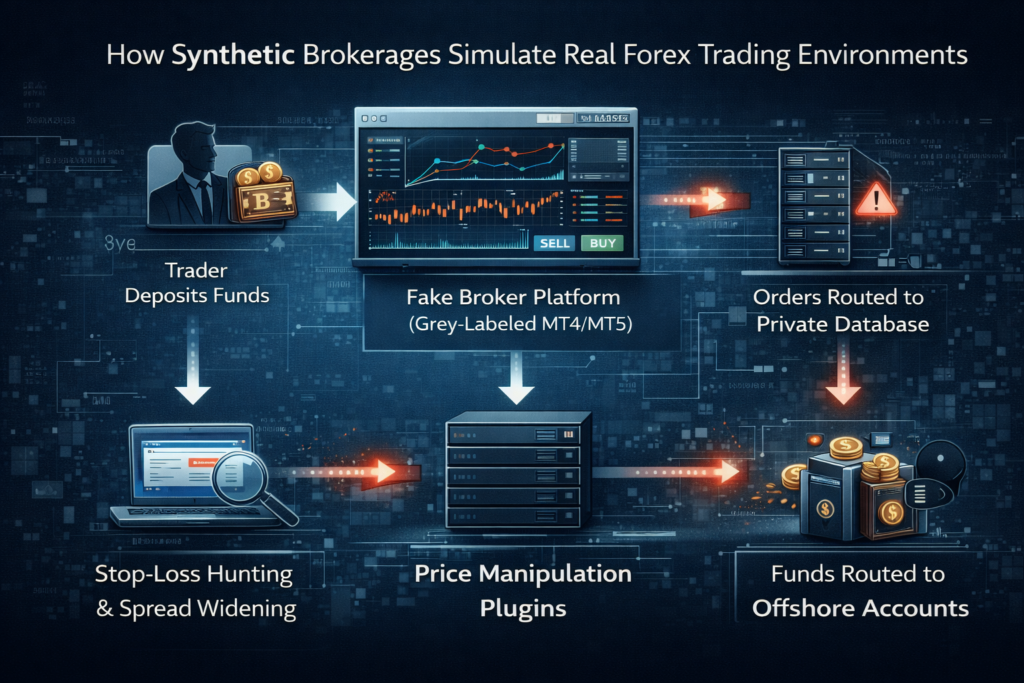
Today, criminal organizations purchase “grey-label” licenses for massively popular trading platforms like MetaTrader 4 or MetaTrader 5. A grey label effectively allows them to brand the trading software as their own while piggybacking on the server infrastructure of a larger, often complicit, technology provider. They register a shell company in a notorious offshore jurisdiction, such as St. Vincent and the Grenadines, Vanuatu, or the Marshall Islands. Within 48 hours, they launch a fully functional brokerage.
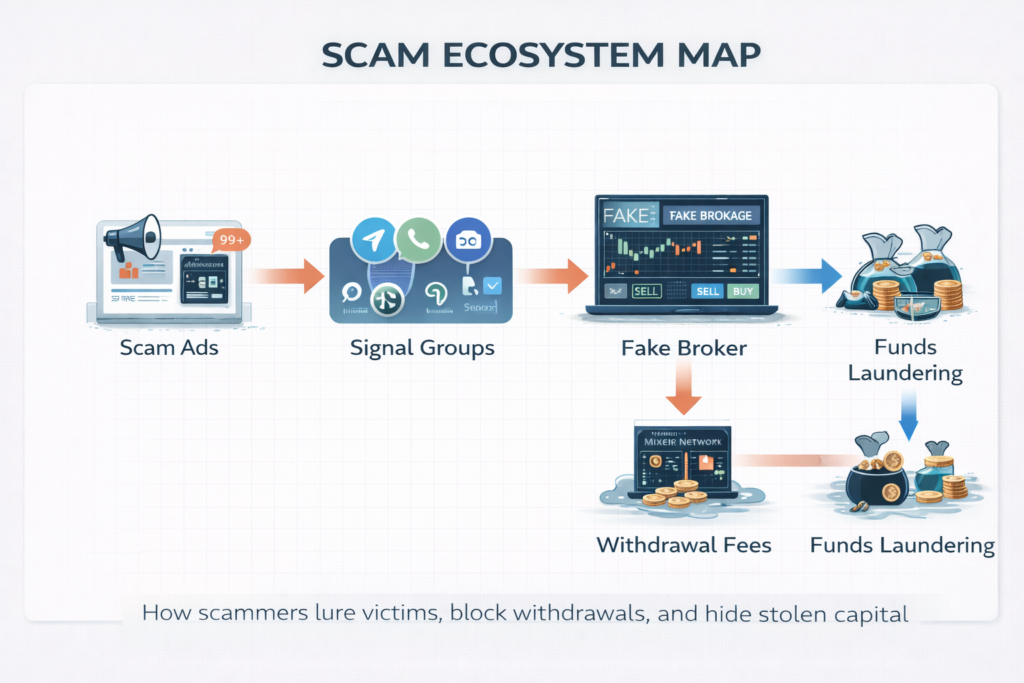
The real deception happens silently on the backend. These platforms are absolutely not plugged into real interbank liquidity. They are closed-loop simulations where price feeds are slightly, maliciously manipulated. The syndicate uses software plugins to actively hunt client stop-losses, artificially widen spreads during high-impact news events, and create asymmetrical slippage. When you hit “buy,” your order doesn’t go to the market. It goes directly into a private database controlled by the syndicate. The fiat or crypto you deposited was laundered through a decentralized mixer or a web of shell accounts days ago.
Top Forex Trading Scams Active This Month
The tactics mutate weekly. Syndicates constantly reverse-engineer regulatory crackdowns and pivot to entirely new narratives. Here is exactly what is destroying retail accounts this month.
1. The Web3 Liquidity Pool Illusion
With the explosive rise of tokenized real-world assets (RWAs), scammers have found a highly lucrative angle. They approach crypto-native traders with a compelling pitch: provide liquidity for decentralized foreign exchange pairs. The promise is massive yield derived from algorithmic arbitrage between decentralized exchanges (DEXs) and traditional FX brokers.
The victim is instructed to deposit stablecoins (like USDT or USDC) into a smart contract that allegedly mirrors a fiat currency pair, such as EUR/USD or GBP/JPY. Initially, the dashboard shows incredible yield, and the smart contract actually pays out small withdrawals to build deep trust. Once the victim commits a massive sum of capital, the deployer calls a hidden function in the smart contract—often a simple withdrawAll command—and violently drains the entire liquidity pool.
2. AI-Driven Signal Bot Fraud
Artificial intelligence is the ultimate marketing buzzword, and fraudsters are weaponizing it aggressively. Across YouTube, TikTok, and X, you will see endless advertisements for “proprietary AI trading algorithms”. These bots boldly claim to use machine learning and natural language processing to read central bank sentiment and execute high-frequency trades.
These are rudimentary forex trading scams wrapped in highly sophisticated marketing. The victim is required to purchase a license for the bot and deposit funds into a specific “partner broker”. That partner broker is an unregulated offshore shell controlled by the exact same people selling the bot. The bot actually strings together a few winning trades initially. The next day, the bot suddenly opens massively over-leveraged positions in the completely wrong direction, blowing the account to zero in minutes.
3. Next-Generation Romance Baiting (Pig Butchering 3.0)
The industrial-scale scam known as “pig butchering” has drastically evolved. Syndicates are now deploying hyper-realistic deepfakes, cloned voice notes, and highly detailed background stories to build intimate, months-long relationships with their targets.
The operative slowly, carefully introduces the idea of forex trading. They don’t ask for money directly; instead, they frame it as sharing a secret wealth-building strategy. They might claim their uncle works in institutional liquidity. They expertly guide the victim to download a legitimate crypto wallet, further building trust, before convincing them to authorize a malicious decentralized application (dApp) or deposit funds into a spoofed MT5 terminal.
4. Unregulated Prop Firm Rug Pulls
Proprietary trading firms exploded in popularity over the last three years. The premise is deeply attractive: pass a trading evaluation, prove you can manage risk, and trade the firm’s capital for a lucrative profit split.
Unfortunately, a massive wave of fraudulent operations has flooded the market. These scam firms operate on a pure churn-and-burn model. It is a thinly veiled Ponzi structure. When a trader consistently pulls profits, the scam prop firm will suddenly terminate their account, citing vague “breaches of algorithmic trading rules” or “toxic order flow”. They simply collect evaluation fees until the negative reviews pile up, then rebrand under a new domain name.
Blacklisted: Scam Platforms Flagged This Month
To understand the sheer scale of these operations, we must look at the recent collapses of massive syndicates that devastated retail traders.
- Aura Global Yield: This massive syndicate positioned itself as a bridge between decentralized finance and institutional FX liquidity. They required users to lock USDC in their proprietary smart contract, displaying consistent 2% weekly returns on a fake frontend dashboard. On a quiet Sunday morning, the smart contract was drained of $42 million in a single transaction by the deployer address itself. The founders immediately boarded flights to non-extradition countries.
- Apex Funding Core: This fraudulent prop firm aggressively marketed a $100,000 funded account for a mere $250 evaluation fee. When a small percentage of highly skilled traders actually passed the evaluation and requested their first profit split, Apex immediately halted all payouts. They retroactively updated their terms of service overnight to ban the exact trading strategies their successful clients had used, stealing millions in evaluation fees.
Spotting the Red Flags Before You Deposit
Survival in this environment requires extreme, uncompromising paranoia. You must analyze every counterparty like an institutional auditor.
Examine the deposit infrastructure carefully. Legitimate, regulated brokers strictly use tier-one banking rails and accept wire transfers directly to matching corporate accounts. If a broker asks you to deposit via Bitcoin, Tether, or an obscure third-party payment processor based in Cyprus, stop immediately.
Scrutinize the regulatory licensing. A flashy website displaying a registration number from an island nation means absolutely nothing. You are looking for active, verifiable oversight from top-tier authorities like the US Commodity Futures Trading Commission (CFTC), the UK Financial Conduct Authority (FCA), or the Australian Securities and Investments Commission (ASIC).
Finally, watch for execution anomalies. If your withdrawal requests are met with sudden demands for “withdrawal taxes,” “liquidity fees,” or “AML clearance deposits,” you are already a victim. A legitimate financial institution will never ask you to deposit more money just to access your existing funds.
Forex Scam Recovery: The Brutal Reality of Getting Your Money Back
When the screen goes dark and the realization hits, sheer panic sets in. This is exactly when traders make their second fatal mistake. The internet is absolutely swarming with secondary fraudsters aggressively promising guaranteed forex scam recovery. These fake “white-hat hackers” and “legal retrieval firms” target desperate victims, demanding steep upfront retainer fees to execute completely nonexistent chargebacks or blockchain hacks.
Let’s be absolutely clear about the mechanics of recovery in 2026. If you wired fiat currency to an offshore bank, traditional bank wire recalls are highly ineffective once the funds hit the destination account. The SWIFT system moves fast, but criminals move much faster.
If you deposited via cryptocurrency, the situation is different, though equally complex. Professional chainalysis involves meticulously tracing the flow of stolen stablecoins through decentralized mixers (like Tornado Cash), cross-chain bridges, and eventually to a centralized exchange (CEX). Once traced to an exchange like Binance or Kraken, you must work immediately with law enforcement to serve a freeze order to the exchange’s compliance department. Exchanges strictly require a police report, a subpoena, or a court order to hold the funds permanently.
This exhausting process takes months, sometimes years, and requires specialized lawyers and jurisdictional cooperation. If anyone promises you a quick return of your funds for a $1,000 upfront fee, you are simply being scammed again.
Securing Your Capital Moving Forward
Operating in the modern financial markets requires a strict zero-trust architecture. You simply cannot afford to take a broker’s word for anything. Verify the liquidity, verify the regulatory status, and explicitly verify the underlying smart contracts.
The syndicates are actively counting on your greed and your ignorance. They build incredibly beautiful traps meticulously designed to bypass your logical defenses. The only way to survive the current landscape is to master the mechanics of the platforms you use and treat every unsolicited financial opportunity as a hostile threat.
Nobody is going to protect your money but you. Stay sharp, verify everything, and never wire capital into the dark. For real-time threat intelligence, vetted recovery guidance, and the most up-to-date blacklist of fraudulent brokers, always consult Bitcoin Scam Watch before you risk a single dollar.
Report A Scam

Recent Posts
-
 Top Forex Scams to Avoid This Month: A Survival Guide by Bitcoin Scam Watch
 -
 Exposing Tasttytrade.com: A Dangerous Imposter Scam Preying on Investors
 -
 New Cryptocurrency Scam Platforms in 2026 Explained By Bitcoin scam watch
 -
 Rising Crypto Scams in 2026 – Experts Reveal Recovery Options
 -
 AI Trading Scams Surge in 2026 – Experts Warn Investors About Fake Crypto Platforms