The screen refreshes, and the balance flashes zero. A cold, heavy silence follows. The digital wealth you spent years accumulating, the portfolio you meticulously dollar-cost averaged into, has vanished into the cryptographic void. Panic is the immediate, visceral response. You stare at a string of unauthorized transaction hashes, feeling entirely violated by an invisible adversary.
For years, the mainstream narrative dictated that cryptocurrency transactions were akin to handing a stranger unmarked cash in a dark alley. The myth was absolute: once it is gone, it is gone forever.
In 2026, that narrative is completely dead.
The blockchain is not a black hole; it is the most aggressive, unblinking financial surveillance system ever architected by human hands. Every single token movement, every microscopic gas fee paid, and every decentralized swap is permanently etched into a public ledger. Criminal syndicates utilizing advanced pig butchering scams, fake Web3 exchanges, and malicious smart contract drainers rely entirely on your ignorance of this fact. They want you to give up.
You are not going to give up.
This comprehensive, institutional-grade manifesto breaks down the exact forensic realities, the aggressive legal frameworks, and the precise crypto scam recovery methodologies required to hunt down digital thieves.
Can lost bitcoins ever be recovered?
When the panic subsides, the ultimate, desperate question emerges: Can lost bitcoins ever be recovered? The answer is a definitive yes, but it fundamentally depends on the specific mechanics of your loss.
We must ruthlessly separate the romanticized Hollywood hacking myths from the cold, hard realities of data science. Blockchains like Bitcoin and Ethereum are inherently immutable. This means that a finalized transaction cannot be reversed, rolled back, or magically canceled by pressing a button. There is no customer service hotline for the Bitcoin network.
However, immutability does not equal invisibility. Because the ledger is completely transparent, the recovery of stolen assets does not rely on “hacking” the blockchain. It relies on meticulous, elite-level blockchain forensics. Investigators deploy advanced heuristic clustering algorithms to visually trace the exact path of your stolen funds. They follow the money through decentralized mixers, across complex Layer-2 bridges, and straight to the deposit address of a centralized exchange.
Once the stolen Bitcoin hits a heavily regulated exchange that enforces strict Know Your Customer (KYC) laws, the criminal’s anonymity instantly evaporates. Legal teams execute subpoenas, freeze the accounts, and unmask the thief, transitioning the case from a cryptographic puzzle into a traditional asset seizure. So, yes, recovery is entirely possible, provided you act with blinding speed and mathematical precision.
How do I find Bitcoin I bought years ago?
Before diving into the aggressive pursuit of scammers, we must address a completely different, yet equally common, form of digital loss. What if your crypto wasn’t stolen by a malicious actor? How do I find Bitcoin I bought years ago? During the massive bull runs of the early 2010s and the 2020/2021 cycle, millions of retail investors bought fractions of Bitcoin, moved them to obscure software wallets, and simply forgot about them. Finding this “lost” crypto requires a completely different digital archeology protocol.
- Identify the Custody Model: Did you leave the Bitcoin on a centralized exchange (like Coinbase, Binance, or the now-defunct Mt. Gox or FTX)? If it is on an active exchange, a simple password reset and identity verification protocol can restore access. If the exchange went bankrupt, you must register as a creditor in the ongoing bankruptcy proceedings to receive a fractional payout.
- The Hunt for the Seed Phrase: If you used a non-custodial software wallet (like Exodus or Electrum) or a hardware wallet (like Ledger or Trezor), the entire security of that wallet rests on a 12 to 24-word recovery phrase (the mnemonic seed). Search your physical files, old safe deposit boxes, and encrypted hard drives. If you possess those words, you can restore your wallet on any modern interface in seconds.
- Brute-Forcing Legacy Wallets: What if you have the old
wallet.datfile from a 2014 Bitcoin Core download, but you forgot the encryption password? Legitimate cybersecurity firms specialize in ethical password recovery. By utilizing massive, GPU-accelerated server farms and your partial memory of the password (e.g., “I know it had my dog’s name and a special character”), they can ethically brute-force the decryption of your legacy file.
However, if your seed phrase is permanently destroyed and your private keys are completely lost, that Bitcoin is permanently burned. Cryptography is mathematically unforgiving.
I got scammed how to get money back
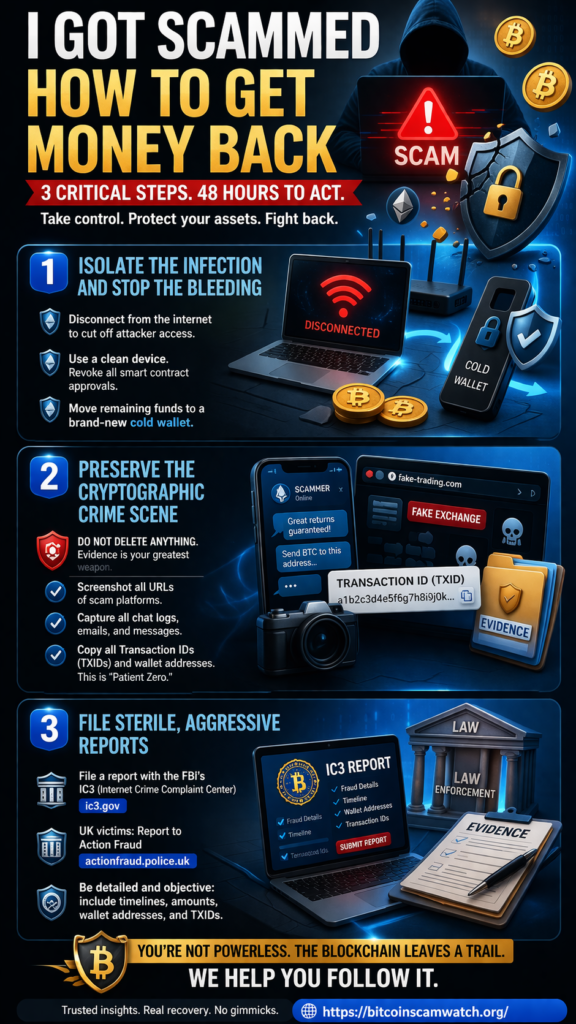
If your loss was not a simple memory lapse, but rather a targeted, malicious extraction, the protocol shifts violently from digital archeology to active cyber-warfare. If you are sitting there realizing, “I got scammed how to get money back,” you must execute the following immediate triage protocol. The first 48 hours dictate the ultimate success or failure of your entire case.
Step 1: Isolate the Infection and Stop the Bleeding
Do not simply close your browser tab. If you clicked a malicious link or interacted with a fake Web3 platform, your device may be actively compromised by a remote access trojan (RAT) or an automated sweeper bot. Physically sever your internet connection. Using a completely separate, clean device, immediately revoke all active smart contract approvals associated with your Web3 wallet using verified tools. If you have any remaining assets, violently transfer them to a brand-new, cold storage hardware wallet.
Step 2: Preserve the Cryptographic Crime Scene
The initial instinct is often absolute disgust—a desire to delete the fraudulent app, block the scammer on WhatsApp, and wipe the computer clean. Do not do this. You are actively destroying the precise forensic evidence required to hunt them. Take high-resolution screenshots of absolutely everything.
- Capture the exact URLs of the fake trading platforms.
- Screenshot every single chat log, email, and direct message.
- Most importantly, copy the exact Transaction IDs (TXIDs) or hashes where your Bitcoin left your wallet. This is the “Patient Zero” of the entire investigation.
Step 3: File Sterile, Aggressive Reports
You cannot legally freeze an offshore bank account or a centralized exchange wallet without an official police report. You must file comprehensive fraud reports with federal authorities. In the US, file with the FBI’s Internet Crime Complaint Center (IC3); in the UK, utilize Action Fraud. When filing, be ruthlessly objective. Provide timelines, exact financial figures, and the specific transaction hashes.
How do I get back my lost Bitcoin? (The 2026 Step-by-Step Blueprint)
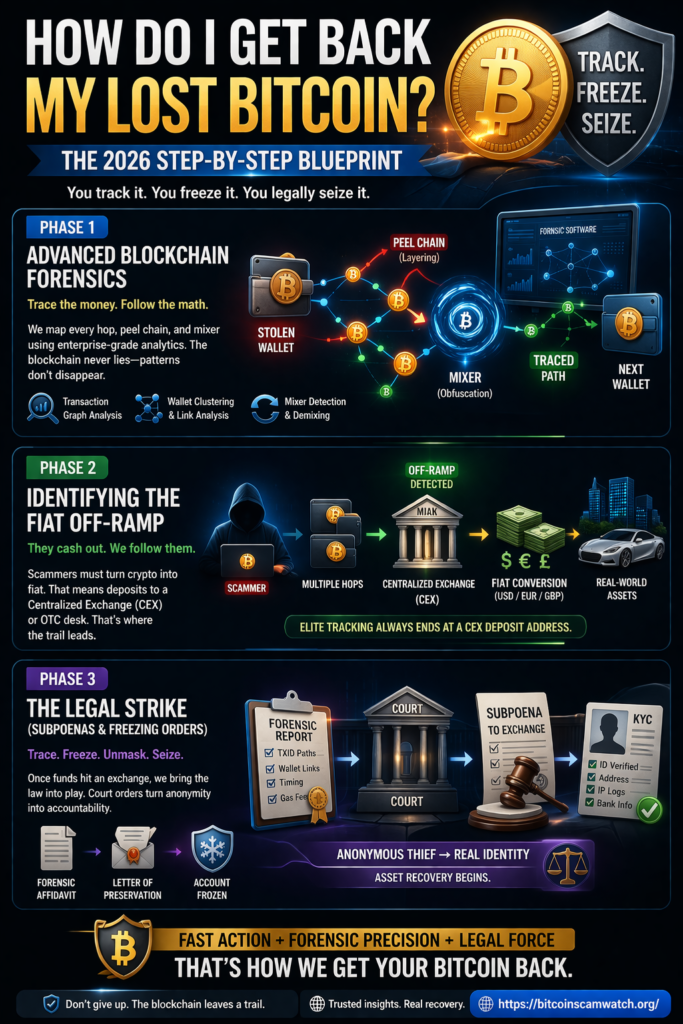
Once the bleeding is stopped and the scene is preserved, the offensive campaign begins. How do I get back my lost Bitcoin? You track it, you freeze it, and you legally seize it.
Phase 1: Advanced Blockchain Forensics
Scammers never leave your stolen Bitcoin sitting in the initial receiving wallet. They deploy automated scripts to launder the capital through a process known as “layering.” They might utilize a “peel chain,” systematically peeling off tiny fractions of the stolen Bitcoin into hundreds of intermediary wallets to mathematically exhaust amateur investigators.
This is where you deploy enterprise-grade blockchain analytics. Elite investigators utilize software platforms capable of mapping complex transaction graphs across dozens of Layer-2 networks simultaneously. They track the liquidity. If 5 BTC goes into a decentralized mixer, the forensic algorithms analyze the exact timing, the withdrawal volumes, and the associated gas fees to “demix” the transaction on the other side. The blockchain never lies; the math always balances.
Phase 2: Identifying the Fiat Off-Ramp
Criminal syndicates do not steal Bitcoin just to look at digital numbers on a screen. They steal it to purchase real-world assets—luxury real estate, massive server farms, and exotic cars. To accomplish this, they face a massive, unavoidable bottleneck. They must eventually convert that digital token into cold, hard fiat currency (USD, EUR, GBP).
To convert crypto to fiat, they are forced to use an off-ramp. Almost universally, this means depositing the stolen Bitcoin into a Centralized Cryptocurrency Exchange (CEX) or an Over-The-Counter (OTC) trading desk. Elite tracking always ends at a CEX deposit address.
Phase 3: The Legal Strike (Subpoenas and Freezing Orders)
Once the funds are definitively traced to an exchange like Binance, Kraken, or OKX, the technical battle ends and the legal war begins.
Your legal counsel drafts a comprehensive, court-admissible forensic affidavit proving the exact lineage of the stolen funds from your wallet directly to the exchange. They serve a “Letter of Preservation” to the exchange’s legal department, legally compelling them to instantly freeze the scammer’s account before the funds can be withdrawn.
Following the freeze, attorneys file a “John Doe” civil lawsuit against the anonymous owner of the wallet address. The presiding judge issues a binding, international subpoena to the exchange, forcing them to hand over the scammer’s complete KYC (Know Your Customer) profile. Suddenly, the anonymous digital thief has a government ID, a physical home address, and a traceable bank history. Asset recovery then seamlessly transitions into a standard, traditional legal seizure.
What is the best crypto recovery service?
The sheer complexity of on-chain forensics and cross-border litigation means this is absolutely not a DIY project. You need professional intervention. However, this necessity breeds the most dangerous secondary threat in the Web3 ecosystem. Victims frantically searching for “What is the best crypto recovery service?” are routinely targeted by devastating “Recovery Room Scams.”
The internet is flooded with predatory operations heavily promising guaranteed, frictionless recovery. Anonymous Instagram accounts flaunt screenshots of recovered millions. Sleek, corporate-looking websites claim they possess proprietary “backdoor software” capable of hacking the blockchain to reverse your transaction.
They are all lying.
These fraudsters operate an incredibly cruel advance-fee scam. They will analyze your transaction hash, show you a fake, complex diagram proving they have “found” your funds, and then demand an upfront “smart contract reversal deposit” or a “blockchain miner’s fee” paid exclusively in cryptocurrency. Once you pay the fee, they demand another, bleeding you dry when you are at your absolute most vulnerable.
How to Identify a Legitimate Bitcoin Recovery Service
A genuine, ethical Bitcoin recovery service operates with institutional transparency. Here is how you separate the apex predators from the true professionals:
- No Guarantees: Legitimate investigators never, ever guarantee a successful recovery. The geopolitical and technical variables are far too immense.
- No Upfront Crypto Payments: Reputable forensic firms and specialized law practices generally accept traditional fiat payments via wire transfer or credit card, offering clear legal recourse, binding contracts, and standard corporate paper trails.
- No Hacking Claims: A real investigator will flatly tell you that reversing a finalized blockchain transaction is mathematically impossible. They do not “hack.” They perform data science, chain clustering, and complex legal litigation.
- Verifiable Credentials: They possess recognized industry certifications, such as the Chainalysis Reactor Certification (CRC), and they operate in tandem with verified, licensed attorneys capable of actually serving subpoenas to global exchanges.
Reclaiming Your Digital Sovereignty
The psychological trauma of having your digital wealth violently stripped away is profound. The massive syndicates operating these sophisticated frauds—from fake Web3 liquidity pools to highly coordinated pig butchering rings—rely entirely on your feelings of hopelessness, shame, and sheer isolation. They desperately want you to quietly accept the loss and fade away.
You must refuse to give them that satisfaction.
The digital world leaves an unblinking, permanent trail. By moving with absolute, blistering speed, aggressively documenting the cryptographic crime scene, filing ruthless, sterile reports with the proper global authorities, and utterly refusing to fall victim to secondary recovery scams, you transform from a passive victim into an active, highly dangerous adversary.
The fight to reclaim your stolen digital assets is undeniably arduous, highly technical, and emotionally exhausting, but it is unequivocally not impossible. Equip yourself with the harsh, mathematical facts. Verify every single counterparty you deal with. Lean on dedicated, deeply ethical threat-intelligence communities to navigate the complex darkness of the blockchain.
For continuous, institutional-grade education, real-time vetted scam alerts, and the absolute, unvarnished truth about navigating the complexities of on-chain forensic tracing, always consult the experts at Bitcoin Scam Watch before you take your next step.
The criminals are counting on you to surrender. The permanent ledger gives you the power to prove them wrong. Stay deeply paranoid, trust nothing but the raw data, and strike back.